
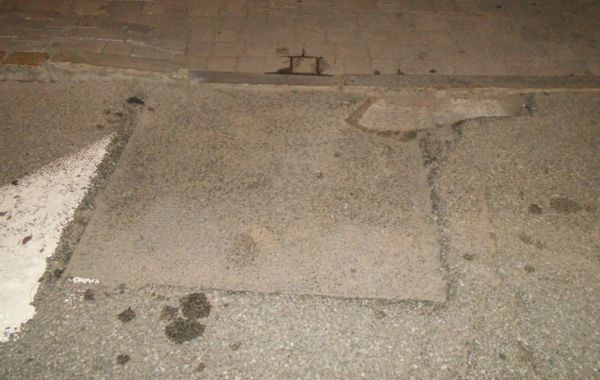
A dangerous roadway defect that many people might dismiss as “just a pothole” resulted in a serious ankle fracture and ultimately a $500,000 settlement against the State of New York after extensive litigation.
The case arose when a pedestrian crossing a street stepped from the curb into a dangerous depression adjacent to the curb line—a defect that was significantly deeper than it appeared and created a serious hazard for anyone walking through the area at night.
The defect is shown in the photograph above: a patched roadway area immediately adjacent to a curb where the pavement had deteriorated, creating a dangerous drop-off.
What Made This Condition Dangerous?
In this case, the hazardous condition involved:
- a roadway cut-out adjacent to the curb
- deteriorated asphalt
- uneven elevation between curb and pavement
- a hidden pothole within a patch area
- a defect difficult to appreciate while walking at night
The measurements established that the defect created a substantial elevation differential, making it far more dangerous than an ordinary pavement irregularity.
The injured pedestrian stepped into the defect while crossing the street and sustained a fractured ankle requiring significant treatment.
Municipal Liability: Why These Cases Are Difficult
When injuries occur on municipal roads, streets, sidewalks, or public crossings, the legal analysis requires proof that the defendant:
- created the dangerous condition, or
- had actual notice, or
- had constructive notice long enough that repairs should have been made
In this case, the evidence ultimately established that the dangerous condition had existed long enough that roadway maintenance personnel should have discovered and repaired it.
Constructive Notice Can Win a Dangerous Defect Case
The court found that the defect likely existed for months before the injury and that maintenance crews had worked in the area multiple times before the accident occurred. That was critical proof.
Even though there was no direct proof that anyone formally reported the pothole, the evidence showed:
- repeated freeze-thaw deterioration
- visible pavement breakdown
- repeated maintenance presence nearby
- a defect that should have been discovered during roadway inspections
That allowed liability to be established.
Why Photographs Matter in Fall and Defect Cases
A photograph taken immediately after an incident can become one of the most important pieces of evidence.
In roadway defect and sidewalk defect litigation, photographs help establish:
- size of defect
- depth of defect
- lighting conditions
- surrounding repair history
- visibility of hazard
Without photographs, dangerous conditions are often repaired before evidence can be preserved.
Timing Is Critical in Municipal Injury Cases
Municipal claims have much shorter deadlines than ordinary negligence cases.
In many municipal injury cases:
- Notice of Claim deadlines may apply within 90 days
- Evidence must be preserved immediately
- Repair records must be obtained quickly
Trip and Falls Result in Serious Injuries
Severe Broken Ankle Injury: Surgery, Chronic Pain, and Permanent Limitations
A serious broken ankle injury can cause permanent pain and long-term physical limitations. In this case, she suffered a displaced trimalleolar fracture of the left ankle, a severe ankle fracture involving three parts of the ankle joint, requiring immediate surgery.
She underwent open reduction and internal fixation surgery, where plates and screws were used to stabilize the fracture.
Recovery was difficult. She completed more than 30 physical therapy sessions, later requiring nerve blocks and pain injections because the pain never fully resolved. She still wakes up every day with stiffness and describes her ankle as feeling like “a block of wood” until she stretches it.
Before the injury, she ran three times per week, skied regularly, and played tennis, volleyball, and basketball. Today, exercise causes ankle swelling and increased pain.
Like many people dealing with chronic pain after ankle fracture surgery, she also faces daily lifestyle changes: she no longer wears heels, has gained weight because she cannot exercise normally, and has developed right knee pain from favoring the injured leg.
At age 55, this injury represents decades of ongoing pain and limitation—demonstrating how a severe ankle fracture can become a permanent orthopedic injury.
Dangerous Defect Injury Lawyer in Albany and Upstate New York
At LaMarche Safranko Law, we handle injury cases involving:
- potholes
- sidewalk defects
- roadway hazards
- municipal negligence
- dangerous property conditions
